
2026-10-10 · Scott Wilson
Why Your AC Struggles During Nevada Afternoon Heat
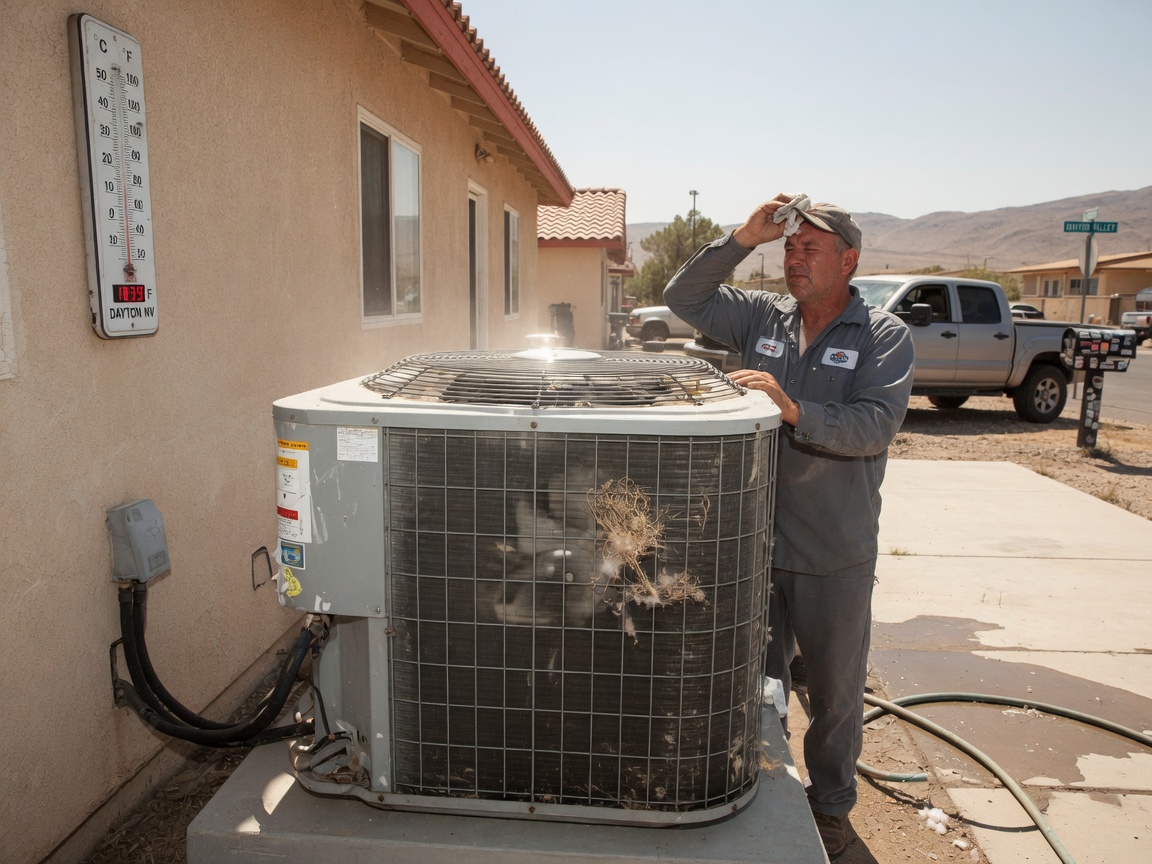
Your AC struggles during Nevada afternoon heat because daytime highs in Lyon County often climb 25–35 degrees above morning lows, forcing units to run continuously while outdoor coils sit in 100-plus-degree air. In Dayton this pattern repeats daily from June through September, especially when winds stay calm near Dayton State Park and Historic Dayton Courthouse.
High Desert Temperature Swings
Dayton sits in a high desert basin where morning temperatures in the 60s can reach the upper 90s by 2 p.m. These rapid rises hit homes in Old Town Dayton hardest because many structures built before 1990 have single-pane windows and minimal attic insulation. The same swing affects newer builds in Dayton Valley when south-facing roofs absorb direct sun for six straight hours. Systems sized for an average 85-degree day must reject heat against 105-degree ambient air, raising head pressure and cutting capacity by roughly 20 percent. Residents who also commute to Carson City or Reno notice the same pattern when they return home at peak load time.
Older Housing Stock and Heat Gain
Many homes along Old Town Dayton's original streets were constructed with 2x4 walls and R-11 insulation. Afternoon sun loads push indoor temperatures up faster than modern systems expect, so compressors run longer cycles. In Dayton Valley, ranch-style houses with large west-facing windows experience similar gains once the sun drops below 30 degrees above the horizon. Dust from surrounding sagebrush and gravel roads coats condenser fins, reducing airflow and adding another 5–8 degrees to operating temperatures. These conditions explain why units that perform adequately in Reno or Fernley can short-cycle or freeze up when installed in Dayton without proper sizing adjustments.
Afternoon Load on Common AC Components
The hottest hours between 1 p.m. and 5 p.m. coincide with the highest sensible heat load. Evaporator coils must remove both temperature and the low humidity typical of Lyon County afternoons. When filters load with fine desert dust, static pressure rises and airflow drops below 350 cfm per ton. Capacitors weaken faster under sustained 240-volt draw, and contactors pit from frequent starts. Homeowners can track these effects by noting how long the system runs after sunset; cycles longer than 15 minutes past dark usually indicate the afternoon strain has already reduced efficiency.
Practical Checks Before Peak Season
Walk the perimeter of your Dayton home in late morning and confirm at least 24 inches of clearance around the outdoor unit. Remove any cottonwood or sage debris that accumulated over winter. Replace the indoor filter every 30–45 days during summer rather than the standard 90-day schedule. If your system is 8–12 years old, schedule a pre-summer inspection through AC Repair to verify refrigerant charge and clean coils before the first 100-degree day. Readers dealing with frequent filter changes may also want to review Common AC Filter Problems In Dayton Nevada Homes for additional steps that protect equipment during prolonged heat.